7 Signs Your Bra Size Is Wrong (and How to Fix Each One)
Your bra is trying to tell you something. The riding band, the digging straps, the cups that never quite sit right — these aren't things you have to live with, and they're not a sign that your body is "difficult." They're diagnostic signals: each one points to a specific sizing error with a specific fix.
Below are the seven most common signs your bra size is wrong, what each one means, and exactly how to fix it — including when the answer is a sister size rather than a whole new size. If you want the positive version of this guide (what a good fit looks like), see our 5-point fit check.
1. The Band Rides Up Your Back
The symptom: by midday, the back of your band has crept up toward your shoulder blades, sometimes sitting several inches higher than the front. You keep tugging it down, and it keeps migrating back up.
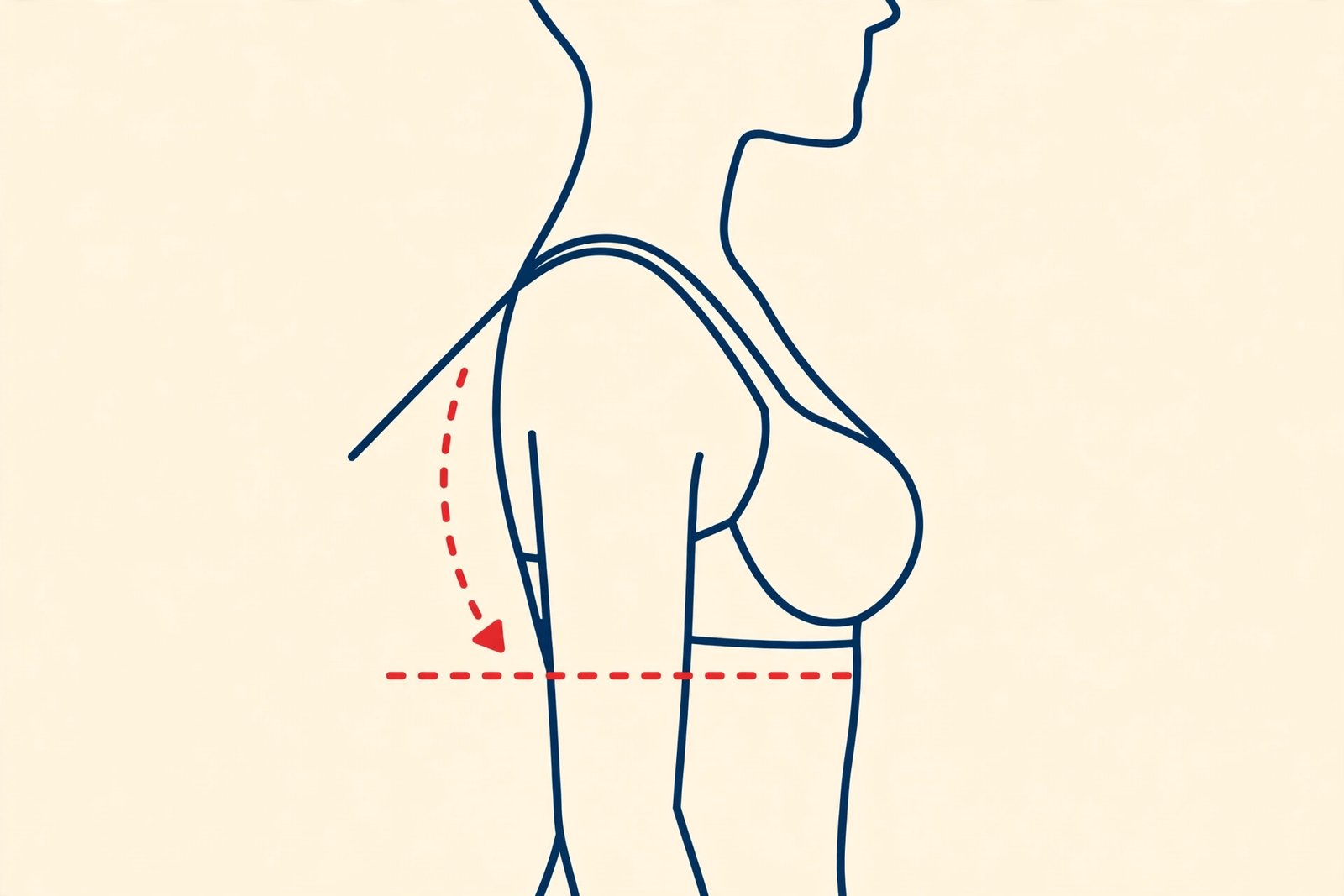
What it means: your band is too loose. The band's job is to anchor firmly on your ribcage; when it can't grip, the weight of the bust pulls the front of the bra down, which levers the back upward like a seesaw. This is the single most common bra fit problem, and it almost always means the band size — not the cup — is the culprit.
The fix: go down one band size and up one cup letter to keep the same cup volume — a sister size. A 36B becomes a 34C; a 38D becomes a 36DD. The tighter band will anchor properly. Our sister size calculator works this out for any starting size in seconds.
Check first: make sure you're wearing the bra on the loosest hooks. If you're already on the tightest hooks and the band still rides, the band is definitely too big. Also note that old bras do this naturally as elastic wears out — if a bra that used to fit now rides up, it may be worn out rather than wrongly sized. The average bra lasts 6–12 months of regular wear with proper rotation.
2. Spillage Over the Top or Sides
The symptom: breast tissue bulges over the top edge of the cups (the "quad-boob" effect — four visible bumps instead of two smooth curves), or escapes toward the underarms, creating side bulges under your arms.
What it means: the cups are too small. There's more breast tissue than the cups can contain, so it finds the nearest exit — over the top, out the sides, or both. Note that side spillage can also happen when the underwire is too narrow for your breast root even if the cup volume is roughly right, which is a shape issue as much as a size issue.
The fix: go up one cup letter, keeping the same band (34C becomes 34D). If spillage persists after going up a cup, the style's cup shape may be too shallow or narrow for you — try a style with deeper cups or wider wires rather than continuing to size up blindly. And if the spillage is mainly at the sides near the underarm, check that the underwire fully encircles your breast tissue and sits flat against your ribcage.
Don't confuse with: a plunge or push-up style, which deliberately shows more upper fullness. Spillage is a problem when tissue is compressed and bulging against the cup edge, not when a style simply reveals a natural curve.
3. Gaping or Wrinkling Cups
The symptom: the top edge of the cups stands away from your body, leaving a visible gap — or the cup fabric wrinkles and collapses even when you're standing still. It's most obvious when you lean forward or move your arms.
What it means: usually, the cups are too large. But there's an important second possibility: a shape mismatch. If the cups fit well at the bottom and sides but gape only at the very top, you may simply have less upper fullness than the style expects. In that case the size might be right and the cut wrong.
The fix: first try going down one cup letter (34C becomes 34B). If the smaller cup then feels tight or causes spillage, the volume was right and the shape was wrong — switch to a different cut instead. Balconette and demi-cup styles suit less upper fullness; full-coverage styles suit more. Trying the same size in two different cuts is often more revealing than trying two sizes in the same cut.
4. Straps Dig In or Slip Off
The symptom: deep red grooves on your shoulders at the end of the day — or the opposite problem, straps that constantly slide off no matter how you adjust them.
What digging means: counterintuitively, digging straps usually signal a band that's too loose, not straps that are too tight. When the band can't support the bust, the straps take over the load and carve into your shoulders. Tightening the straps further just relocates the misery. The real fix is a snugger band: check that the band is level, then consider a sister size down one band (and up one cup). If the band is already snug and level, switch to wider, padded straps, which distribute weight over more area.
What slipping means: the straps are set too wide for your frame, the band is too loose (letting the whole bra shift), or the elastic has simply stretched with age. Tighten the straps first and check both sides are even — uneven adjustment is a surprisingly common cause. If they still slip, look for styles with closer-set, racerback, or convertible straps. Petite-framed wearers often do better with brands that scale strap placement for smaller frames.
5. Underwire Digs or Sits on Breast Tissue
The symptom: the underwire pokes, digs into your ribs, or — most tellingly — rests on top of breast tissue instead of flat against your ribcage around it.
What it means: wire sitting on breast tissue means the cup is too small or too narrow for your breast root — the wire can't get around the tissue, so it sits on top of it. This is both uncomfortable and a clear diagnostic: the cup needs more room. Wire digging at the centre front can also mean the gore is too high or rigid for a close-set shape.
The fix: go up one cup letter first. If the wire still sits on tissue, the issue is likely wire width rather than cup volume — try brands or styles known for wider wires, or a style with a lower centre gore. Persistent wire pain at the sides can also come from a band that's too tight, pulling the wires hard against the ribs; if going up a cup doesn't help, try the sister size up one band (and down one cup).
When to skip the wire entirely: some people simply never get comfortable in underwires, and that's fine. A well-fitting wireless bra with a firm, wide band can support surprisingly well — judge it by the same band, cup, strap, and comfort checks as any other bra.
6. Back, Shoulder or Neck Pain by Evening
The symptom: a dull ache between the shoulder blades, sore shoulders, or neck tension that builds through the day and eases when the bra comes off.
What it means: poor support distribution. In the great majority of cases, the chain of causation runs: band too loose → band can't support → straps take the load → shoulders and neck pay the price. Larger busts magnify the effect, but the mechanism is the same at any size. Less commonly, a band that's painfully tight can cause rib soreness directly.
The fix: prioritise the band. Re-check that it's level and snug (two fingers under the back band), and if it's loose, sister-size down. Many people are astonished at how much shoulder and neck tension disappears once the band — not the straps — is doing the work. If pain persists with a demonstrably good fit, it's worth mentioning to a doctor or physiotherapist, since posture and muscle factors can contribute independently of bra fit.
7. You Adjust It Constantly
The symptom: you tug the band down, hoist the straps up, reposition the cups, or re-scoop throughout the day — the bra never quite stays where you put it in the morning.
What it means: this is the meta-symptom: a bra that fits doesn't need managing. Constant adjusting usually means something in the size is off, even if no single check screams failure. Common underlying causes: a band that's slightly too loose (everything migrates), cups slightly too small (tissue shifts and needs re-scooping), or straps that have stretched past their useful life.
The fix: run the full 5-point fit check and note which checks fail — the pattern will point at the culprit. And be honest about the bra's age: elastic degrades, and a bra that's done a year of faithful service may simply be worn out. No size fixes a dead band. As a rule of thumb, rotate at least 3–4 bras, hand-wash or machine-wash in a lingerie bag on gentle, and retire bras whose bands no longer recover their snap.
What to Do Next: Fix Your Size in 3 Steps
Recognised yourself in one or more signs? Here's the practical path forward:
- Re-measure. Bodies change — weight shifts, exercise, pregnancy, and age all move the numbers. Follow our step-by-step measuring guide (ten minutes, one soft tape measure) and write down your underbust and bust.
- Calculate. Run your measurements through our bra size calculator for an estimated size in US, UK, EU and more systems — and use the sister size calculator to note your one-band-up and one-band-down alternatives before you shop.
- Verify on your body. Try the new size (and, when possible, its sister sizes in the same style) and run the 5-point fit check. Change one thing at a time — band or cup, not both — so you can tell which change helped.
One last piece of perspective: there is no single "true" size stamped on your body. Sizes are estimates, brands cut differently, and fabrics behave differently. The goal was never a magic number — it's a bra you forget you're wearing. Measure, calculate, verify, and trust the mirror and the evening comfort test over any label.
Frequently Asked Questions
How do I know if my bra band is too big?
The classic test: it rides up your back during the day, you can pull it several inches away from your body, or you need the tightest hooks on a new bra. A correct band sits level all the way around, fits snugly on the loosest hooks when new, and lets you slide about two fingers underneath — no more.
What does it mean when my bra cups spill over?
Spillage over the top or sides means the cups are too small for your breast tissue — there's more volume than the cups can contain. Go up one cup letter keeping the same band. If spillage continues, the style's cup shape may be too shallow or narrow for you, and a different cut may work better than another size up.
Why do my bra straps dig into my shoulders?
Usually because the band is too loose. When the band can't support the bust, the straps take over the load and dig in. The fix is a snugger band (often via a sister size down one band, up one cup) rather than loosening the straps. If the band is already snug and level, try wider, padded straps.
Should I go up a band size or a cup size?
It depends on the symptom. Band problems (riding up, shifting) → adjust the band via a sister size, changing the cup letter in the opposite direction to preserve volume. Cup problems (spilling, gaping) → change the cup letter, keeping the band the same. Never change both at once, or you won't know which change helped.
How often should I replace my bras?
With regular wear and rotation (3–4 bras in rotation, gentle washing), a bra lasts roughly 6–12 months before the elastic degrades. Signs it's done: the band rides up even on the tightest hooks, straps won't stay adjusted, or cups have lost their shape. A worn-out bra can't be fixed by re-sizing — replace it.
Can the wrong bra size cause back pain?
It can contribute. The usual mechanism is a too-loose band that can't support the bust, forcing the straps to carry the load — which strains the shoulders, neck, and upper back by evening. Fixing the band fit (snug, level, doing ~80% of the support work) resolves this for many people. Persistent pain is worth discussing with a doctor or physiotherapist.
Try It Yourself
Reading about sizing is useful — measuring is better. Grab a tape measure, take your two measurements, and get your estimated size in under a minute.