How to Measure Your Bra Size Correctly at Home
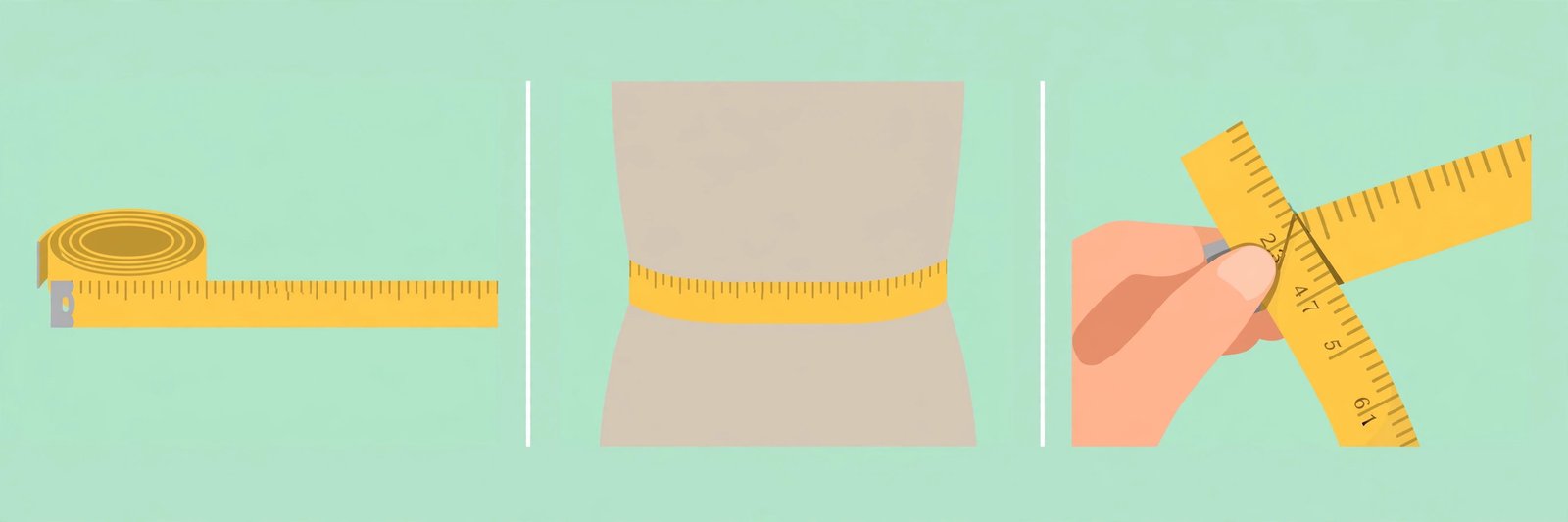
Buying a bra without knowing your measurements is a lot like buying shoes without knowing your shoe size — you might get lucky, but you probably won't. A tape measure, a mirror, and about ten minutes are all it takes to get a reliable estimate of your bra size at home. This guide walks you through each step: what to wear, where to place the tape, how to read the numbers, and how to turn two measurements into a size you can actually shop with.
The method below gives you an estimated size, which is the same kind of starting point that bra-fitting specialists use before trying styles on. Sizing varies between brands and styles, so treat your result as a strong starting point rather than a final verdict. If you want the math done for you, our bra size calculator uses the same steps described here.
What You'll Need
You probably already own everything on this list. There is no need for specialist equipment.
- A soft measuring tape. The flexible kind used for sewing, not a metal builder's tape. If you don't have one, you can use a piece of string and measure it against a ruler afterwards — but a proper soft tape is easier and more accurate.
- A mirror. A full-length mirror is ideal because it lets you check that the tape is level around your body. Holding the tape level matters more than most people realise.
- An unpadded, non-minimising bra (or no bra). Measure over a thin, unpadded bra or a well-fitting sports top if you prefer some support while measuring. Thick padding or a push-up bra will distort the bust measurement and give you a cup size that doesn't match your body.
- A pen and paper or your phone. Write each measurement down as you take it. Relying on memory is a classic way to end up with the wrong numbers.
- Five to ten quiet minutes. Measuring in a rush leads to sloppy tape placement. Stand comfortably and breathe normally.
For the bust measurement, switch to something unpadded — or measure without a bra if that's comfortable for you.
How to Measure Your Underbust
The underbust measurement determines your band size — the number in a bra size such as 34C. The band does most of the supporting work in a bra, so this measurement deserves your full attention.
- Stand up straight with your arms relaxed at your sides. Stand in front of the mirror so you can watch the tape.
- Wrap the tape directly under your bust, right where the band of a bra would sit — where breast tissue ends and your ribcage begins. The tape should rest flat against your skin all the way around.
- Keep the tape level. Check in the mirror that the tape runs horizontally around your back. A tape that rides up at the back will give you a smaller number than the truth, and a tape that dips down will give you a larger one.
- Breathe normally and read the number on a neutral exhale. The band has to be comfortable while you breathe.
- Pull the tape snug but not tight. It should be close against the body with no slack, but not digging into your skin. You should just be able to slip a finger underneath.
- Write down the number to the nearest half inch (or nearest centimetre if your tape uses metric — our calculator accepts both).
Underbust measuring tips
- If the number falls between whole inches, write down the exact figure — the rounding happens in the calculation step, not while measuring.
- Measure twice. If the two readings differ by more than half an inch, take a third and use the one that appears twice.
- Don't add extra inches to the underbust "for comfort." Older sizing advice told people to add 4–5 inches to the underbust, but modern bands are designed to stretch, and adding inches is one of the most common reasons people end up with a band that rides up. Use your true measurement.
How to Measure Your Bust
The bust measurement, combined with the underbust, determines your cup size. It is the measurement around the fullest part of your bust — usually across the nipples.
- Keep standing straight with your arms relaxed. Some people find it easier to let their arms rest gently on top of their head, but relaxed at the sides is fine — just don't raise them high, which lifts the bust and changes the number.
- Wrap the tape around the fullest part of your bust. For most people this is at nipple level. The tape should glide over the fullest point rather than pressing it down.
- Keep the tape level all the way around. Check in the mirror — the tape often slides up at the back here, which shrinks the number. Adjust until the tape is horizontal in the mirror's view.
- Keep it comfortably loose. Unlike the underbust, the bust tape should sit against the body without compressing breast tissue. If the tape is flattening you, your cup estimate will come out too small.
- Breathe normally, read, and write it down.
Bust measuring tips
- If your bust is fuller or your breast tissue is soft, you may find the number changes slightly with posture. Measure standing upright in your natural posture — don't arch your back or slouch.
- For the advanced calculation method, you can also take the bust measurement while leaning forward at about 90 degrees and while lying flat on your back, then average the three. Leaning forward lets tissue hang naturally and can give a fuller reading for some body types. Our calculator's advanced mode walks you through exactly that.
- If you're between sizes or your weight fluctuates, measure when you're feeling like yourself — there's no ideal time of day, just avoid measuring right after a very large meal if your ribcage expands noticeably.
How the Calculation Works
Once you have your two numbers, the maths is refreshingly simple. There are two steps:
Step 1 — the band. Take your underbust measurement and round it to the nearest even number. Bra bands are sold in even numbers (28, 30, 32, 34, and so on), so this rounds your real measurement to the closest size you can actually buy. An underbust of 33 inches rounds to a 34 band; 35.5 inches rounds to a 36 band.
Step 2 — the cup. Subtract your band size from your bust measurement, then round the difference to the nearest whole number. Each inch of difference corresponds to one cup letter: 1 inch is an A cup, 2 inches a B, 3 inches a C, 4 inches a D, and so on through DD, DDD, and beyond. (The exact letter sequence differs slightly between the US and UK systems once you pass DD — our US, UK and EU chart guide explains the difference.)
That's the whole method. It is an estimate, and a useful one: it gets most people into the right neighbourhood, and from there, trying a couple of nearby sizes — including sister sizes — usually lands the fit.
A Worked Example
Let's say your measurements are:
- Underbust: 34 inches
- Bust: 37 inches
Band: 34 is already an even number, so the band size is 34.
Cup: 37 minus 34 equals 3 inches of difference. The third cup letter (A = 1, B = 2, C = 3) is C.
Estimated size: 34C.
Try it yourself with a second example: an underbust of 31 inches and a bust of 36 inches. The underbust rounds to the nearest even number, 32, giving a 32 band. The difference is 36 − 32 = 4 inches, the fourth cup letter — a D. Estimated size: 32D.
If you'd rather not do the arithmetic, enter your numbers in our bra size calculator and get your estimated size in both US and UK sizing instantly.
Common Mistakes to Avoid
Small measuring errors create big sizing errors, because a one-inch difference can change your cup letter entirely. Watch out for these:
- Measuring over a padded bra. Padding adds phantom volume. Measure over an unpadded bra or a thin top, or without a bra.
- Pulling the tape too tight at the bust. Compressing tissue shrinks the bust number and underestimates the cup. Snug at the underbust, gentle at the bust.
- Letting the tape drift at the back. This is the single most common error. The back view in the mirror is your quality control — keep the tape level.
- Adding inches to the underbust. The old "+4 inches" rule is outdated. Modern bands are designed to fit your real measurement, and adding inches leads to a band that rides up your back.
- Rounding while measuring. Write down the exact number and round only in the calculation. Rounding twice compounds the error.
- Using one old measurement forever. Bodies change with weight shifts, exercise, pregnancy, and age. If your bras suddenly fit differently, re-measure rather than re-ordering your old size.
- Treating the calculator result as the final word. The estimate is a starting point. Bra brands cut differently — especially across US, UK, and EU sizing systems, which is why we made a dedicated bra size chart and a sister sizes guide for fine-tuning.
Quick Size Chart Reference
Use this table to sanity-check your result. Find your underbust row for the band, then find your bust-minus-band difference in the cup row.
| Underbust (in) | 28–29 | 30–31 | 32–33 | 34–35 | 36–37 | 38–39 | 40–41 | 42–43 |
|---|---|---|---|---|---|---|---|---|
| Band | 28 | 30 | 32 | 34 | 36 | 38 | 40 | 42 |
| Difference (in) | 1 | 2 | 3 | 4 | 5 | 6 | 7 | 8 |
|---|---|---|---|---|---|---|---|---|
| US cup | A | B | C | D | DD | DDD | G | H |
For the full picture — UK and EU bands, the complete cup progressions, and US/UK/EU conversions — see our bra size chart guide.
Frequently Asked Questions
Should I measure with a bra on or off?
Either works, as long as the bra is unpadded and non-minimising. A thin, well-fitting unpadded bra gives a stable result; measuring without a bra also works if you are comfortable. Avoid push-up or padded bras, which inflate the bust measurement and overestimate your cup size.
Why is my calculated size different from the bras I currently wear?
Several reasons: your body may have changed since you last measured, your old size may never have been quite right, or your brand may cut larger or smaller than average. The calculated size is an estimate and a starting point — try it alongside one size up and down to find what feels best.
How often should I re-measure my bra size?
Re-measure whenever your bras stop fitting comfortably, and at least once a year as a habit. Weight changes, new exercise routines, pregnancy, breastfeeding, and hormonal shifts can all change your measurements.
Do I need to add inches to my underbust measurement?
No. The older +4/+5 inch rule is outdated. Modern bra bands are designed to stretch and fit your actual underbust measurement, so use the true number. Adding inches is one of the most common causes of a loose, ride-up band.
What if my measurements fall between two sizes?
Try both, and consider sister sizes. If the band feels slightly tight but the cups are right, a sister size one band up (and one cup down) may be more comfortable — our sister size calculator can find them for you.
Are US and UK sizes calculated the same way?
The measuring and band steps are the same; the difference is in cup letters above DD. The US goes DD, DDD, G, H while the UK goes DD, E, F, FF, G. So a 34DDD in US sizing is labelled 34E in UK sizing. Our US and UK calculator pages explain each system in detail.
Try It Yourself
Reading about sizing is useful — measuring is better. Grab a tape measure, take your two measurements, and get your estimated size in under a minute.