How to Find the Right Bra Size and Understand Sister Sizes
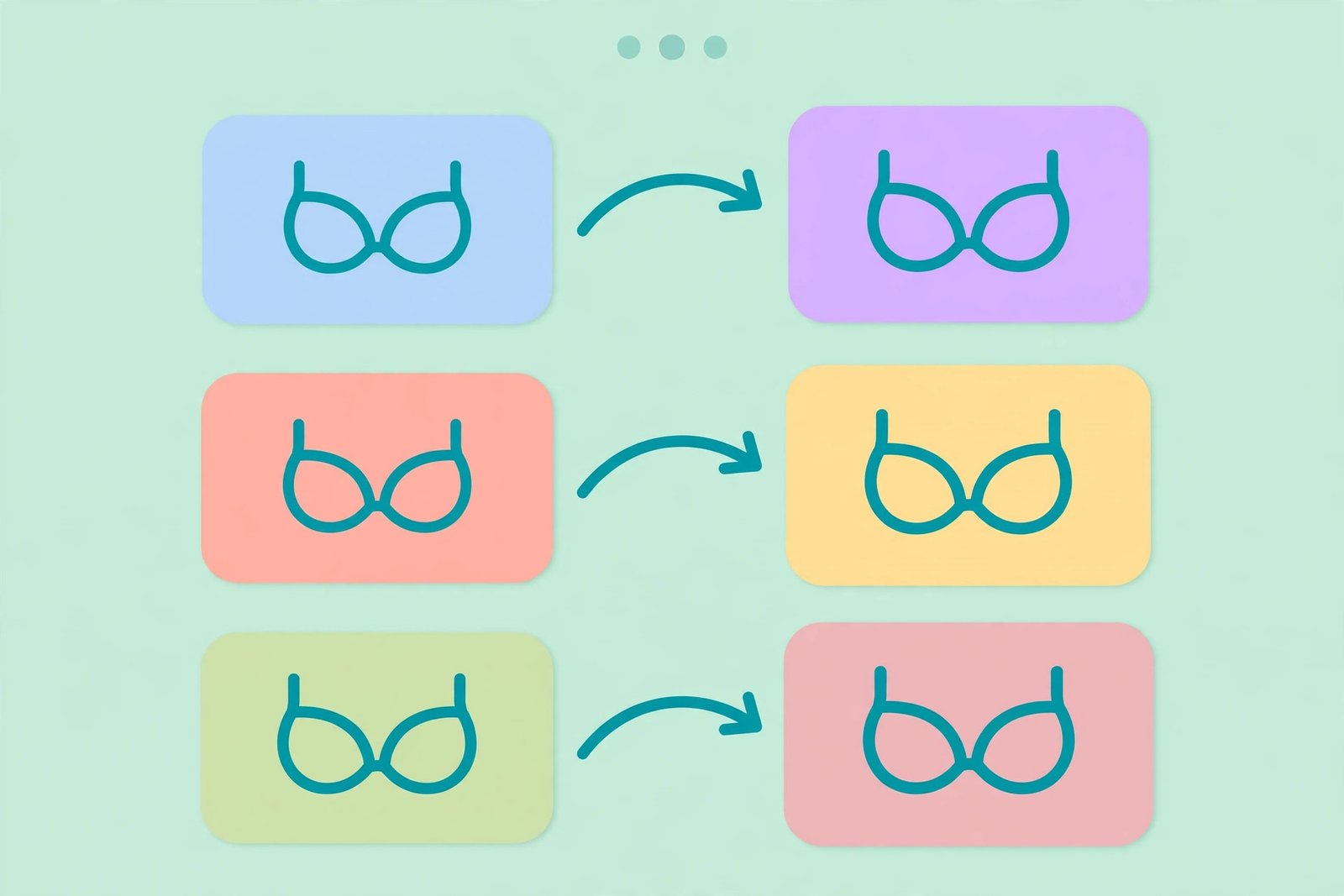
You find a bra you love, but your size is sold out — or your usual size suddenly doesn't feel right. Before you give up, there's a useful trick worth knowing: sister sizes. These are the sizes one step up or down the band that hold roughly the same cup volume as your size. Understanding them turns bra shopping from a guessing game into a small, manageable set of options — and it often solves fit problems that look mysterious at first.
This guide explains what sister sizes are, the simple rule behind them, and exactly when to reach for one. Our sister size calculator finds yours instantly — the explanation below shows why its answers make sense.
What Are Sister Sizes?
A bra size has two parts: the band (the number, like 34) and the cup (the letter, like C). The band describes the length around your ribcage; the cup letter describes the difference between your bust and your band — in other words, the cup's volume relative to the band.
Here's the key insight: cup letters are relative, not absolute. A D cup on a 32 band holds less volume than a D cup on a 38 band, because the letter measures the difference from the band, and the bands are different lengths. This means the same cup volume can appear under different letter labels on different band sizes.
Sister sizes are the pairs of sizes that share approximately the same cup volume while the band changes. For a 34C, the sister sizes are 32D (one band down, one cup up) and 36B (one band up, one cup down). The cups hold about the same amount, but the band fits a smaller or larger ribcage.
The Band-Up, Cup-Down Rule
Sister sizing follows one simple rule:
- Go down a band, go up a cup. The smaller band is tighter, so the cup letter goes up one step to keep the same volume: 34C → 32D.
- Go up a band, go down a cup. The larger band is looser, so the cup letter goes down one step to keep the same volume: 34C → 36B.
The band changes in steps of 2 (..., 30, 32, 34, 36, ...) and the cup changes one letter per step. Each move preserves the cup volume while adjusting the band fit. You can chain the rule two steps out, but one step in either direction is the practical limit — the further you move from your measured band, the more approximate the volume match becomes.
One caution: "same volume" is approximate, not exact. Sister sizes are close enough that the rule works well in real fitting rooms, but a sister size is not a clone of your size — the band fit genuinely changes, which is precisely the point. Treat sister sizes as the nearest alternatives, not as identical twins.
Sister Size Examples
Let's make the rule concrete with the examples most people ask about.
34C → 32D and 36B
Start with a 34C. Move one band down: the band becomes 32, and the cup goes up one letter from C to D — giving 32D. Move one band up instead: the band becomes 36, and the cup goes down one letter from C to B — giving 36B. All three (32D, 34C, 36B) hold roughly the same cup volume.
36D → 34DD and 38C
Start with a 36D. One band down: 34 band, cup up one letter from D to DD — 34DD. One band up: 38 band, cup down one letter from D to C — 38C. The 34DD has the tighter band; the 38C has the looser one; the cups are near-equivalent.
UK example: 34E → 32F and 36DD
The rule works identically in UK sizing — just follow the UK cup sequence (..., DD, E, F, FF, ...). Start with a UK 34E. One band down: 32 band, cup up from E to F — 32F. One band up: 36 band, cup down from E to DD — 36DD. (In US sizing, that starting size would be labelled 34DDD, with sisters 32G and 36DD — see our US/UK/EU chart guide for why the letters differ.)
Notice the pattern in every example: the band number and the cup letter always move in opposite directions. If both move the same way — say 34C to 36D — that's not a sister size; that's a genuinely larger bra in both dimensions.
When to Try a Sister Size
Sister sizes aren't just trivia — they solve specific, common fit problems. Here's when to reach for one:
- The band rides up your back. A band that creeps upward during the day is usually too loose — it's not anchoring, so the weight shifts to the straps. Try the sister size down a band (and up a cup): 36B → 34C. The tighter band stays put.
- The band feels too tight but the cups are right. If the cups fit well but the band digs or leaves deep marks, try the sister size up a band (and down a cup): 34C → 36B. You keep the cup volume while gaining band comfort.
- Your size is sold out. The most practical use of all. If your size isn't available in a style you want, the sister size one step away is the closest alternative — often close enough to work.
- You're between band sizes. If a 34 band feels slightly loose and a 32 slightly tight in the same style, the sister sizes around your measured size give you the full set of near-options to compare. Try 32D, 34C, and 36B side by side and keep the one that feels best.
- The style runs small or large in the band. Some brands and styles cut their bands tighter or looser than average. Instead of abandoning the style, sister-size around the issue: band too tight? Go up a band and down a cup. Band too loose? Go down a band and up a cup.
What sister sizing can't fix: cups that are fundamentally the wrong volume for you (spilling out or gaping badly even when the band is right), or a style whose shape simply doesn't suit your body. In those cases, re-check your measurements with our measuring guide rather than sister-sizing around a wrong starting point.
Signs of Good Fit vs Bad Fit
To use sister sizes well, it helps to know what you're aiming for. A well-fitting bra has a few clear hallmarks:
Signs of a good fit
- The band is level and snug. It sits horizontally around your body — not riding up at the back — and stays in place when you move. You should be able to fit about two fingers underneath, no more.
- The cups contain without gaps or spilling. Breast tissue sits inside the cups; nothing bulges over the top or sides, and there's no empty fabric wrinkling at the top of the cup.
- The centre front sits flat. The small panel between the cups (the gore) rests against your sternum rather than floating away from it.
- The straps stay put without digging. They should sit comfortably on your shoulders and do only light work — most of the support comes from the band.
- It's comfortable for a full day. The ultimate test. A bra that feels fine for ten minutes but painful by evening isn't the right fit, even if the size looks right on paper.
Signs of a bad fit
- Band riding up the back — the band is too loose; consider a sister size down a band.
- Cups gaping at the top — the cup is too large, or the style's shape doesn't match; try a smaller cup or a different cut.
- Spilling over the top or sides ("quad-boob") — the cup is too small; go up a cup letter.
- Underwire sitting on breast tissue instead of flat against the ribcage — the cup is too small or too narrow.
- Straps digging in or slipping off — often a symptom of a band that's too loose, forcing the straps to do the band's job.
- Back or shoulder pain by day's end — frequently caused by a too-loose band shifting the support burden onto the straps.
How to Find Your Size Step by Step
Pulling it all together, here's a practical process:
- Measure. Take your underbust and bust measurements carefully — our measuring guide covers the technique step by step.
- Calculate your starting size. Use our bra size calculator (or the band-and-difference method) to get your estimated size in US and UK sizing.
- Identify your sister sizes. Note the sizes one band up and one band down, using the band-up/cup-down rule — or let our sister size calculator list them for you.
- Try the trio. When possible, try your measured size plus both sister sizes in the same style. Fit differences between them are immediately obvious on the body in a way no chart can convey.
- Judge by the checklist. Band level and snug? Cups smooth? Centre front flat? Comfortable? Keep the winner.
- Repeat per brand. Sizing varies between brands and even between styles from the same brand. Once you know your size in one brand, use sister sizing — not blind loyalty to the label — when trying a new one. Our bra size chart helps with cross-brand comparisons.
A final reminder: every size on this page is an estimate and a starting point. Bodies differ, brands differ, and fabrics differ. The measuring tape gets you close; your own comfort makes the final call.
Frequently Asked Questions
What is a sister size in bra sizing?
A sister size is a bra size one band up or down from your size that holds approximately the same cup volume. For example, the sister sizes of a 34C are 32D (band down, cup up) and 36B (band up, cup down). They are useful when your size is sold out or when the band fit needs adjusting.
How do I find my sister size?
Use the band-up, cup-down rule: go down one band size and up one cup letter (34C becomes 32D), or go up one band size and down one cup letter (34C becomes 36B). Our sister size calculator does this automatically for both US and UK sizing.
Are sister sizes exactly the same as my size?
No — they are approximately the same cup volume, not identical. The band genuinely fits differently, which is the point: sister sizes let you adjust band tightness while keeping cup volume close to what works for you.
When should I try a sister size instead of my measured size?
Try one when the band rides up (go down a band), when the band digs but the cups fit (go up a band), when your size is sold out, when you're between band sizes, or when a particular style runs tight or loose in the band.
Do sister sizes work the same in UK sizing?
Yes. The rule is identical — just follow the UK cup letter sequence. A UK 34E has sister sizes 32F (band down, cup up) and 36DD (band up, cup down), because in UK sizing the letter after E is F and the letter before E is DD.
Can a sister size fix cups that gap or spill?
Only if the band is part of the problem. Mild issues caused by band looseness or tightness can improve with a sister size. But cups that clearly overflow or gape badly usually mean the cup volume itself is wrong — in that case, re-measure and adjust the cup letter directly rather than sister-sizing around it.
Try It Yourself
Reading about sizing is useful — measuring is better. Grab a tape measure, take your two measurements, and get your estimated size in under a minute.