Advanced Bra Size Calculator
Two measurements give a good estimate. Six measurements give a better one. This advanced bra size calculator uses three underbust readings (loose, snug and tight) and three bust readings (standing, leaning and lying) to smooth out the small measuring errors that can push a two-measurement estimate a cup off in either direction. Enter all six below, in inches or centimeters, and get an estimated size in US, UK, EU, FR, AUS, JP and IN sizing. If you have only two measurements, use the simple bra size calculator instead — and if you are unsure how to measure at all, read how to measure your bra size first.
The idea is simple: no single reading is perfect. Your bust changes slightly with posture, and your underbust changes slightly with how hard you pull the tape. Taking three readings of each and letting the calculator work from the most representative ones — the snug underbust for the band, and the average of the three bust readings for the cup — gives a steadier result than any one reading on its own. The result is still an estimate, not a fitting verdict: sizing varies between brands and styles, so try your result on alongside a sister size or two.
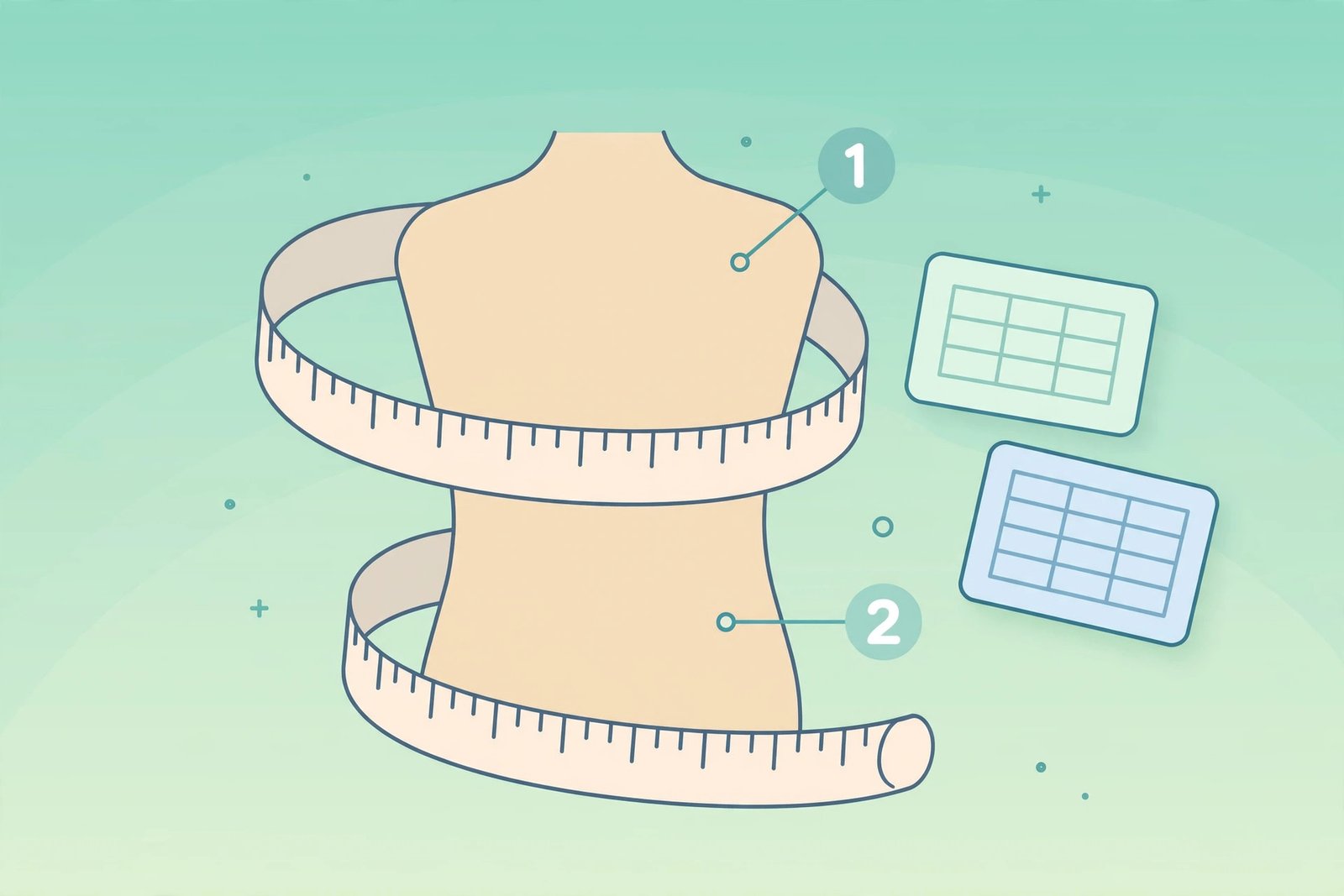
Enter Your Measurements
Advanced mode uses three underbust and three bust measurements for a more refined estimate. Measuring guide.
How to Take the Six Measurements
You need a soft measuring tape, a mirror, and an unpadded bra or a thin top. Take each reading twice if the first two disagree, and write every number down as you go — do not round while measuring; the rounding happens in the calculation. Measure in inches or centimeters, whichever your tape shows most clearly.
1. Loose underbust
Wrap the tape directly under your bust, where a bra band would sit, and let it rest against your skin with no pull at all — just touching all the way around. Breathe out normally and read the number. This is your loosest underbust reading.
2. Snug underbust
In the same place, pull the tape until it is close against your body with no slack, but not digging in — you should just be able to slip a finger underneath. This is the reading the calculator uses for your band, so take your time with it and check in the mirror that the tape is level around your back.
3. Tight underbust
Still in the same place, pull the tape as tight as you comfortably can on a full exhale, as if you were measuring for the firmest band you could tolerate. This reading is not used in the calculation itself — it is your sense-check. If your snug reading sits far from both your loose and tight readings, one of the three was probably taken with the tape unlevel or at the wrong tension, and it is worth re-measuring.
4. Standing bust
Stand upright with your arms relaxed at your sides and wrap the tape around the fullest part of your bust, usually at nipple level. Keep the tape level all the way around and let it sit against your body without compressing breast tissue. Read the number on a normal exhale.
5. Leaning bust
Bend forward at the hips to about 90 degrees, so your torso is roughly parallel to the floor and your bust hangs naturally, then wrap the tape around the fullest part again. For many people this is the fullest of the three bust readings, because gravity lets the tissue hang freely instead of spreading against the chest wall.
6. Lying bust
Lie flat on your back on a firm surface and wrap the tape around the fullest part of your bust. This is usually the smallest of the three bust readings, because the tissue spreads outwards when you are lying down. Together, the three bust readings capture how your bust behaves in different positions instead of trusting a single posture.
A note on order: take the three underbust readings first, then the three bust readings, and write each one down before moving on. If any two readings of the same measurement differ by more than half an inch (about 1 cm), take a third and use the value that appears twice.
How the Calculation Works
The math behind the advanced calculator is the same straightforward sizing math as the simple mode, with two refinements: the band comes from your snug underbust, and the cup comes from the average of your three bust measurements.
- Unit conversion. If you enter centimeters, the calculator first converts every measurement to inches by dividing by 2.54. All sizing math runs in inches.
- Band size — from the snug underbust. The band rule depends on the country you pick: US, UK and IN round your snug underbust to the nearest even inch (32, 34, 36…); EU and JP round your snug underbust in centimeters to the nearest 5 (75, 80, 85…); FR adds 15 to the EU band (90, 95, 100…); AUS subtracts 22 from the inch band (10, 12, 14…). Your loose and tight readings are not used in this step — they are there so you can sense-check the snug reading.
- Cup size — from the average of three bust readings. The calculator averages your standing, leaning and lying bust measurements, then subtracts the band and rounds the difference to a whole number. A bigger difference means a bigger cup. Averaging matters because a single bust reading can be thrown off by posture: the leaning reading often runs fuller and the lying reading often runs smaller, and the average sits between them.
- Why six measurements beat two. A one-inch error in a single bust reading can shift your cup by a full letter. Averaging three readings taken in different positions spreads that error out, and using the snug underbust — checked against your loose and tight readings — anchors the band to your most repeatable measurement.
- Cup letters by country. Cup letters diverge between systems — for example, a 4-inch bust-to-band difference is a D cup in US and UK sizing but an E cup in EU, FR and AUS sizing. India follows UK-style cup letters. Pick the country used by the brands you shop.
- An estimate, not a verdict. Sizing varies between brands, styles, and manufacturers, so no formula can guarantee a perfect fit. Use your result as a starting point, try bras on, and adjust from there.
Keep Exploring
Your estimated size is only the beginning. These resources help you measure accurately, check alternatives, and solve fit problems when the size looks right but the bra still does not feel right:
- How to measure your bra size — a step-by-step guide to measuring your underbust and bust at home.
- Sister size calculator — find alternative sizes with a similar cup volume but a different band.
- Fit problem solver — work out whether a fit problem is the band, the cup, or the style.
- Maternity bra calculator — sizing that accounts for the changes of pregnancy and nursing.
- Brand size decoder — make sense of a brand label that does not match the size you expected.
- How to measure your bra size correctly at home and how to find the right bra size and understand sister sizes — longer fitting guides on the blog.
Frequently Asked Questions
What are the six measurements in the advanced calculator?
Three underbust readings — loose, snug and tight, all taken directly under the bust — and three bust readings — standing, leaning forward, and lying flat — all taken around the fullest part of the bust. You can enter them in inches or centimeters.
Why take three underbust measurements if only the snug one sets the band?
The band is calculated from your snug underbust alone. The loose and tight readings are a sense-check: if your snug reading sits far from both of them, one of the three was probably taken with the tape unlevel or at the wrong tension, and re-measuring is worth it before you trust the result.
Why average three bust measurements instead of using one?
Your bust measurement changes slightly with posture — the leaning reading often runs fuller and the lying reading often runs smaller. Averaging the three spreads out small measuring errors, so a single off reading is less likely to shift your cup by a full letter.
Is the advanced result more accurate than the simple mode?
Usually, yes — a little. The six-measurement method smooths out measuring error, so it tends to give a more refined estimate than two measurements alone. It is still an estimate, though: brand sizing varies, and trying the result on is the only way to confirm the fit.
What if my leaning bust is much larger than my standing bust?
That is normal, especially for fuller or softer tissue, and it is exactly why the advanced mode averages the three readings. If the leaning reading is more than about 2 inches larger than the standing one, double-check the tape was level in both positions, then trust the average rather than either reading alone.
Can I enter my measurements in centimeters?
Yes. Choose Centimeters in the unit dropdown and enter your measurements as-is — the calculator converts them to inches by dividing by 2.54 before running the sizing math.